General gynaecology
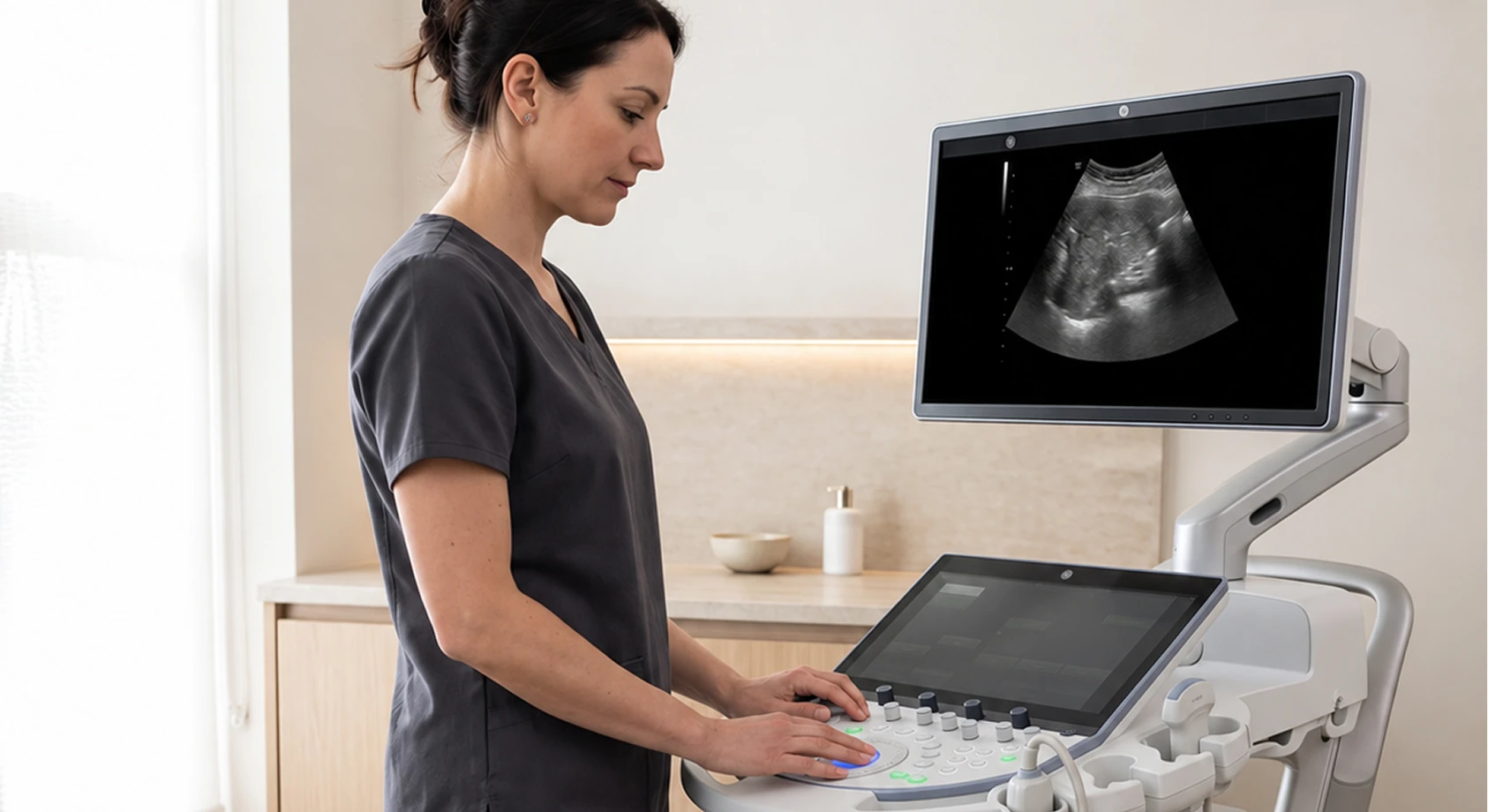
Most gynaecological concerns begin with a symptom that is common and unsettling, and the department is arranged so that the answer does not wait. Assessment and investigation are completed on site during the same attendance: examination, pelvic ultrasound and laboratory analysis are undertaken by your consultant in the room, and the findings are explained before you leave.
· Menstrual and bleeding disorders. Heavy, irregular or absent menstruation and abnormal bleeding, investigated to a cause rather than managed by symptom.
· Pain and infection. Pelvic pain and recurrent infection, examined and cultured on the day.
· Structural findings. Fibroids, ovarian cysts and polyps, characterised by pelvic ultrasound at the consultation, with cervical screening performed where due.
Reconstructive and aesthetic gynaecology
Reconstruction after childbirth, and the correction of asymmetry, scarring or change that a woman finds troubling, are undertaken here by a gynaecologist. Every procedure follows a consultation and a stated interval for reflection before it is scheduled. Regenerative treatment with platelet-rich plasma is available where tissue quality rather than structure is the concern.
· Reconstruction. Perineoplasty and repair following childbirth, scar and asymmetry correction.
· Aesthetic procedures. Labiaplasty, clitoral hood reduction, labia majora reduction, treatment of vaginal laxity and pigmentation correction.
· Labia majora augmentation with fat transfer. Fat is taken from the abdomen or flank under local anaesthetic, prepared, and transferred to the labia majora to restore fullness lost with age, weight change or childbirth, using your own tissue rather than a filler. It is performed as a day-case procedure by a gynaecologist, following consultation.
· Regenerative treatment. Platelet-rich plasma, for treatment of scars and help to rejuvenate the area by increasing the production of new collagen fibres. These injections to the clitoris and anterior vaginal wall, are used in cases for reduced sensation and arousal.
Pregnancy
Early pregnancy is a time when a symptom cannot wait for an appointment, and the department does not ask it to. Bleeding, pain and concern are seen without delay. Viability scanning, four-dimensional ultrasound and the assessment of suspected ectopic pregnancy are performed here. Miscarriage is managed by the same consultant, with the choice of management yours; and where loss has recurred, investigation is undertaken with the Institute’s genetic and endocrine specialists so that a cause is sought rather than assumed.
Contraception
The full range of contraception is available, chosen with you against your health, your history and your plans.
· Long-acting methods. Intrauterine device fitting and removal, including difficult fittings under ultrasound guidance, and subdermal implant insertion and removal. Coil insertion can be performed under sedation upon request.
· Other methods. Hormonal and non-hormonal contraception, chosen with you, and emergency contraception.
Termination of pregnancy
The department provides termination of pregnancy on a separate pathway, with separate scheduling and a private arrival route, and with the same consultant from the first consultation to follow-up. Assessment and scanning are performed at the first attendance, with time to decide and no pressure to do so on the day. Early medical management and surgical termination are both available, with the choice yours and the reasoning for each set out plainly. Contraception is provided at the same attendance where wanted, follow-up is arranged before you leave, and the whole of it is conducted with the discretion the circumstance requires.
Colposcopy and cervical disease
An abnormal cervical screening result is, in the great majority of cases, a precancerous change that is entirely treatable. What makes the difference is how quickly it is examined and how clearly it is explained. The department provides assessment, examination and explanation within a single attendance wherever possible, using colposcopy optics that record each examination so that it can be compared with the last, and treats cervical intraepithelial neoplasia here rather than referring it onward. Surveillance thereafter is by the same consultant, at the interval your finding warrants.
Hysteroscopy and day surgery
Direct examination of the uterine cavity, and the treatment of what is found there, once required a hospital admission and a general anaesthetic. It no longer does. The department performs diagnostic and operative hysteroscopy in an outpatient setting, without general anaesthesia and with same-day discharge, so that polyps are removed, biopsies taken and retained devices retrieved within a morning. You recover in a private suite and are reviewed by your consultant before you leave, and the same consultant who examined you performs the procedure.
Endometriosis and chronic pelvic pain
Endometriosis affects roughly one woman in ten, and the interval from first symptom to diagnosis averages around eight years. The department is built to shorten it. The history is taken without time constraint, because the pattern of pain is the most informative investigation there is; imaging is performed to the dedicated protocol the condition requires, including assessment for adenomyosis, which frequently accompanies it; and management begins at the diagnosis rather than after a referral. Where excision is the right course, a named surgeon is engaged, and your consultant remains responsible for your care throughout.
Vulval disease
Conditions of the vulva are common, treatable, and best managed by a consultant who sees them often. The department holds a dedicated clinic for them, with the vulvoscopy, biopsy and specialist examination that inflammatory, precancerous and painful conditions each require. Lichen sclerosus and lichen planus are treated to control and kept under the surveillance that lichen sclerosus warrants. Vulval intraepithelial neoplasia is followed for as long as it needs to be, and vulvodynia and chronic infection are managed by the same consultant over time, so that a condition that often takes years to name is named at the first visit.
Urogynaecology and the pelvic floor
Urinary incontinence and prolapse are among the most common conditions in women and among the least often raised, and in most cases they are resolved without surgery. The department assesses and stages each condition properly, with urodynamic testing where the picture is unclear, and treats it in the least invasive way that will work. Pelvic floor rehabilitation, pessary fitting, and electromagnetic stimulation of the pelvic floor, and surgical treatment options are provided.

