Cardiovascular assessment
Coronary disease develops over decades without symptoms and is measurable throughout them. This assessment establishes whether arterial disease is present, where it sits and what it is composed of, rather than estimating its statistical likelihood. The particles that cause arterial disease are counted directly, inherited risk that diet and statins cannot alter is measured once, and the arteries themselves are imaged, so that treatment is directed at what is found.
· Blood. Apolipoprotein B counts the particles that cause arterial disease rather than the cholesterol they carry, and diverges from a standard cholesterol result in roughly one person in five. Lipoprotein(a) is inherited, unaffected by diet or statins, and measured once in a lifetime. Advanced sub fractionation sets out the particle sizes behind the totals.
· Computed tomography. The Siemens NAEOTOM Alpha.Pro is a photon-counting scanner, the first to count individual X-ray photons rather than measure their combined energy, giving finer detail at a substantially lower dose. Calcium scoring quantifies established disease; angiography shows the softer plaque that scoring cannot, which is the plaque that ruptures; and analysis of the arterial wall by Cleerly identifies inflammation before plaque has formed.
· Ultrasound. Carotid assessment on the Canon Aplio i800 finds arterial disease where it often appears first. Echocardiography on the GE Vivid E95 includes strain imaging, which measures how the heart muscle deforms rather than only how it moves, and detects impairment years before conventional measures.
· Rhythm and pressure. A resting electrocardiogram, and up to fourteen days of continuous recording with the iRhythm Zio patch, which finds rhythm disturbance that appears once a fortnight and is missed by a single trace. Twenty-four-hour blood pressure monitoring records the overnight pattern that no daytime reading shows, and pulse wave velocity on the AtCor SphygmoCor measures arterial stiffness, an axis of vascular ageing separate from cholesterol.
· Capacity. Cardiopulmonary exercise testing on the COSMED Quark measures maximal oxygen uptake directly, under load, on a cycle ergometer. It is the single measure most strongly associated with how long and how well people live, and it cannot be estimated at rest. Spirometry with reversibility testing detects obstructive and restrictive lung disease before breathlessness is noticed.
Cancer detection
Screening is directed by individual risk rather than delivered as a fixed panel. Age, family history, genomic findings and previous results determine which investigations are appropriate and how often, so that each patient receives the surveillance their own risk warrants and no more. Where a finding arises it is explained at the time, a plan is agreed before you leave, and any treatment required is arranged with a named specialist.
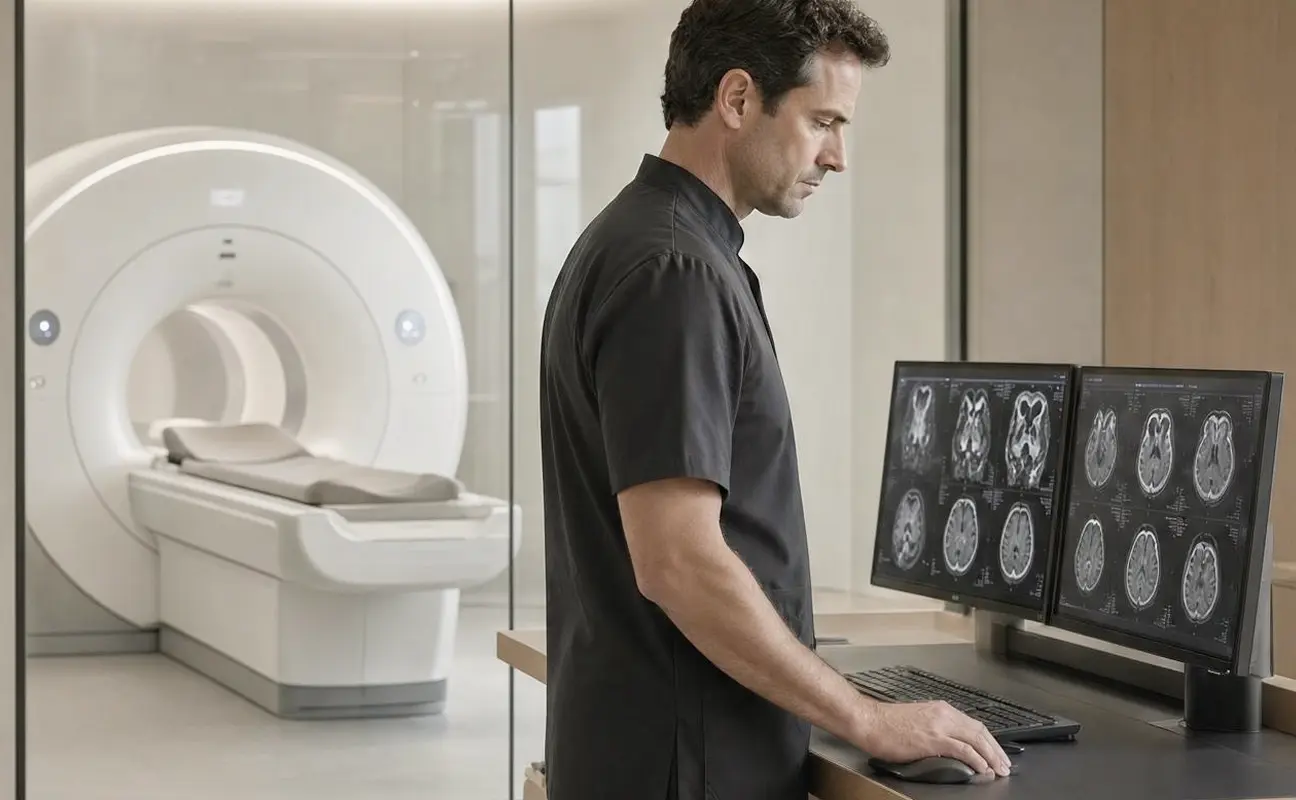
· Magnetic resonance imaging. On the Siemens MAGNETOM Sola, without radiation: the whole body for tumours of the organs and soft tissue; the prostate by multiparametric protocol, which is now the reference investigation before any biopsy is considered; and the breast where tissue is dense and mammography alone is insufficient.
· Computed tomography. Low-dose imaging of the chest for those whose history or exposure warrants it, at a dose that makes annual surveillance justifiable on the photon-counting platform.
· Ultrasound. The abdominal organs and aorta, the thyroid for nodules, the pelvis, and in men the testes, for which ultrasound remains the reference investigation.
· Blood and cytology. Multi-cancer detection analysis by Galleri, which looks for the DNA signature of more than fifty cancers in a single sample, offered with its limitations explained. Prostate-specific antigen interpreted alongside imaging rather than as a number; the composite ovarian index, which combines two markers and is more accurate than either alone; and cervical cytology with extended human papillomavirus genotyping.
· Endoscopy. Colonoscopy and gastroscopy on the Olympus EVIS X1, whose ENDO-AID system flags polyps in real time and is among the few applications of artificial intelligence in medicine with proven outcome benefit. Faecal immunochemical testing is also performed.
· Skin. Full examination with dermoscopy, and total body mapping on the FotoFinder ATBM master, described under Dermatology.
Metabolic assessment
Insulin resistance develops over a decade or more before blood sugar rises, because the pancreas compensates by producing progressively more insulin. Throughout that period, glucose and glycated haemoglobin can remain entirely normal. This assessment is built to identify that phase, while it is still reversible, by measuring insulin directly across a glucose challenge and by examining the organs in which metabolic disease first shows: the liver, the visceral fat, and the kidney.
· Glucose and insulin. A two-hour glucose tolerance test with insulin sampled at four points is the only routine investigation that identifies the years during which the pancreas is compensating while glucose still reads as normal. Fasting insulin and glycated haemoglobin place the result in context, and a fortnight of continuous monitoring with the Dexcom G7 shows how your glucose behaves in ordinary life rather than in a clinic.
· Liver and visceral fat. Transient elastography on the Echosens FibroScan measures liver stiffness and fat content in ten minutes; fatty liver disease is the commonest liver condition and produces a normal blood panel in many of those who have it. Visceral fat, which surrounds the organs and carries risk independently of weight, is measured directly by densitometry.
· Kidney. Cystatin C estimates kidney function more accurately than creatinine, particularly in those with high or low muscle mass, and urinary albumin detects early kidney damage years before it appears in blood.
Neurological and cognitive assessment
Cognitive decline is detected against a person’s own earlier performance, not against a population average, which is why the first assessment establishes a baseline and every subsequent one is compared with it. The structures of the brain associated with memory are measured, the small vessel change that underlies much cognitive decline is quantified, and the arteries that supply the brain are imaged for aneurysm and narrowing, since both are treatable when found early.
· Magnetic resonance imaging. The brain, with the volumes of the structures associated with memory reported against age-matched norms and the burden of small-vessel change quantified; the whole spine; and angiography of the arteries within the head and neck, which identifies aneurysm and narrowing that a torso-only protocol leaves out.
· Cognition. A structured battery from Cambridge Cognition, using parallel forms so that it can be repeated without the improvement that comes from familiarity. Decline is a change in you and cannot be seen without a baseline.
· Retina and vessels. The retina is central nervous tissue, and its vessels are the only part of the circulation that can be photographed directly. Imaged on the Optos MonacoPro across two hundred degrees without dilating drops, with optical coherence tomography of the retinal layers.
Physical function and bone
Strength, cardiorespiratory capacity and bone density are among the measures most strongly predictive of how long and how well a person lives, and among the most responsive to intervention at any age. Bone loss is silent until fracture; muscle quality declines before muscle mass does; capacity under load cannot be estimated at rest. Each is measured directly, and each becomes a target.
· Densitometry. The GE Lunar iDXA is the reference platform for bone mineral density at the spine and hip, where loss is entirely silent until fracture, and for lean mass measured limb by limb. Muscle quality declines before muscle mass does, and this is where it is first seen.
· Strength and function. Grip strength, measured on a Jamar dynamometer in two minutes, is among the most powerful predictors of long-term outcome in the medical literature. Gait speed and balance are recorded alongside it.
· Capacity. Cardiopulmonary exercise testing, described under cardiovascular assessment, which responds to training at any age and has no upper limit of benefit.
Sensory assessment
Hearing loss is among the largest modifiable contributors to dementia risk, and among the most straightforward to correct; untreated vision loss adds to that risk and to the risk of falls. Both are measured properly, and both are acted upon where they are found. The retina, being central nervous tissue, is imaged without dilating drops, so that the remainder of your day is unaffected.
· Hearing. Pure-tone audiometry to high frequency in a sound-attenuating booth. Hearing loss is among the largest modifiable contributors to dementia risk, and among the most straightforward to correct.
· Vision. Visual fields on the Zeiss Humphrey analyser, the reference standard; intraocular pressure for glaucoma, which is silent until sight is lost; and retinal imaging with optical coherence tomography. Untreated vision loss adds to dementia risk and to the risk of falls.
Sleep
Obstructive sleep apnoea is highly prevalent, largely undiagnosed, and causally linked to cardiovascular and cognitive outcome. A home study records your breathing, oxygen and heart rhythm across a night in your own bed, and where the study indicates it, investigation and treatment follow with the relevant specialist.
· Home sleep study. The WatchPAT One records breathing, oxygen and heart rhythm across a night in your own bed, and identifies obstructive sleep apnoea, which is highly prevalent, largely undiagnosed, and causally linked to cardiovascular and cognitive outcome. Where the study indicates it, investigation and treatment follow with the relevant specialist.
Laboratory
Analysis is undertaken in the Institute’s own laboratory, so that some results are with your doctor before you leave. Hormones are measured by mass spectrometry, the reference method, which is accurate at the low concentrations at which immunoassay is not. Autoimmune conditions cluster and their antibodies frequently precede them by years, so autoimmune and immune profiling are performed.
· Blood. Full haematology and biochemistry, inflammatory markers, iron studies, vitamins and micronutrients, analysed in the Institute’s own laboratory.
· Hormones. Thyroid and endocrine profiling on the Sciex Triple Quad 7500, a mass spectrometer, which is the reference method and is accurate at the low concentrations where immunoassay is not, and where accuracy determines the diagnosis.
· Immunity. Autoimmune screening, since antibodies frequently precede the conditions they signal by years; immune profiling by flow cytometry on the BD FACSLyric, which measures how the immune system has aged rather than asserting it; and rapid antibody analysis by Attomarker, reported within the appointment.
· Urine, stool and saliva. Renal and urinary analysis; gastrointestinal analysis for inflammation, exocrine function and occult bleeding; intestinal permeability; and salivary cortisol across the day, which shows the rhythm of the stress axis that a single blood sample cannot.

